
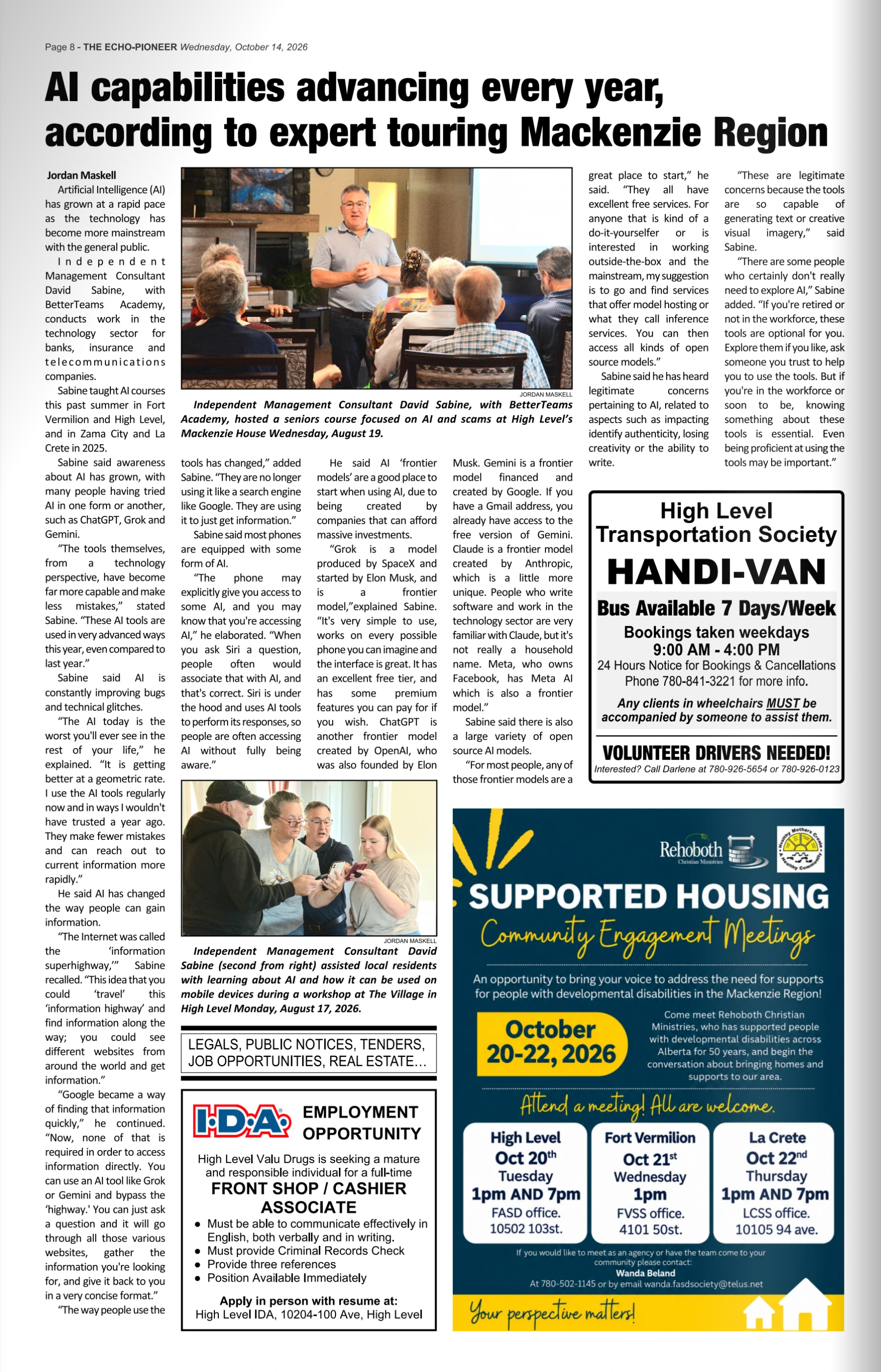
David in Alberta’s Echo Pioneer
Jordan Maskell of the Echo-Pioneer, the newspaper in High Level, wrote about my AI workshops in the Mackenzie Region. The article ran on Wednesday, October 14, 2026. Thank you, Jordan!
AI capabilities advancing every year, according to expert touring Mackenzie Region
By Jordan Maskell, The Echo-Pioneer, Wednesday, October 14, 2026
Artificial Intelligence (AI) has grown at a rapid pace as the technology has become more mainstream with the general public.
Independent Management Consultant David Sabine, of BetterTeams Academy, works with technology companies, banks, insurance companies, and telecommunications companies.
Sabine taught AI courses this past summer in Fort Vermilion and High Level, and in Zama City and La Crete in 2025.
Sabine said awareness about AI has grown, with many people having tried AI in one form or another, such as ChatGPT, Grok and Gemini.
“The tools themselves, from a technology perspective, have become far more capable and make fewer mistakes,” stated Sabine.
Sabine said AI is constantly improving on bugs and technical glitches.
“The AI today is the worst you’ll ever see in the rest of your life,” he explained. “It is getting better at a geometric rate. I use the AI tools regularly now and in ways I wouldn’t have trusted a year ago. They make fewer mistakes and can reach out to current information more rapidly.”
He said AI has changed the way people can gain information.
“The Internet was called the ‘information superhighway,’” Sabine recalled. “This idea that you ‘travel’ this ‘information highway’ and find information along the way; you could see different websites from around the world and get information.”
“Google became a way of finding that information quickly,” he continued. “Now, none of that is required in order to access information directly. You can use an AI tool like Grok or Gemini and bypass the ‘highway.’ You can just ask a question and it will go through all those various websites, gather the information you’re looking for, and give it back to you in a very concise format.”
“The way people use the tools has changed,” added Sabine. “They are no longer using it like a search engine like Google. They are using it to just get information.”
Sabine said most phones are equipped with some form of AI.
“The phone may explicitly give you access to some AI, and you may not know that you’re accessing AI,” he elaborated. “When you ask Siri a question people often would associate that with AI, and that’s correct. Siri is under the hood and uses AI tools to perform its responses, so people are often accessing AI without fully being aware.”
He said AI ‘frontier models’ are a good place to start when using AI, because they come from companies that can afford massive investments.
“Grok is a model produced by SpaceX and started by Elon Musk, and it is a frontier model,” explained Sabine.
“It’s very simple to use, works on every possible phone you can imagine and the interface is great. It has an excellent free tier, and has features you can pay for if you wish. ChatGPT is another frontier model created by OpenAI, which was also co-founded by Elon Musk. Gemini is a frontier model financed and created by Google. If you have a Gmail address, you already have access to the free version of Gemini. Claude is a frontier model created by Anthropic, which is a little more unique. People who write software and work in the technology sector are very familiar with Claude, but it’s not really a household name. Meta, which owns Facebook, has Meta AI, which is also a frontier model.”
Sabine said there is also a large variety of open source AI models. “For most people, any of those frontier models are a great place to start,” he said. “They all have excellent free services. For anyone that is kind of a do-it-yourselfer interested in working outside the box and the mainstream, my suggestion is to go and find services that offer model hosting or what they call inference services. You can then access all kinds of open source models.”
Sabine said he has heard legitimate concerns about AI, such as its impact on identity and authenticity, and the loss of creativity or the ability to write.
“These are legitimate concerns because the tools are so capable of generating text or creative visual imagery,” said Sabine.
“There are some people who certainly don’t really need to explore AI,” Sabine added. “If you’re retired or not in the workforce, these tools are optional for you. Explore them if you like, ask someone you trust to help you to use the tools. But if you’re in the workforce or soon to be, knowing something about these tools is essential. Even being proficient at using the tools may be important.”
Photo captions from the print edition: David Sabine hosted a seniors course focused on AI and scams at High Level’s Mackenzie House on Wednesday, August 19. David Sabine (second from right) helped local residents learn about AI and how it can be used on mobile devices during a workshop at The Village in High Level on Monday, August 17, 2026.
When I visit northern Alberta
It has become a family tradition. Each summer, I travel with my daughters to northern Alberta to visit family and attend FloatFest in Zama City. While I’m there, my niece and sister arrange educational events for the community. This year, I taught two sessions of STEP, the Seniors Tech Empowerment Program: one at The Village in High Level on Monday, August 17, and one at Mackenzie House on Wednesday, August 19. (I also held events in Fort Vermilion this summer, and in Zama City and La Crete in 2025.)
My message to seniors: The danger isn’t the technology
Most people expect the risk to be the AI itself. It isn’t. The risk is urgency.
A fraudster wants you to act before you think. They create fear so you’ll click a link, type a code, or keep talking. AI makes the message more convincing, but the trick is as old as the hills.
So the lesson in the room came down to three rules:
- Notice the urgency. If a message or a call pushes you to act immediately, that pressure is the warning sign.
- Pause. Close the message or hang up. Just hang up. Don’t engage! Then talk with someone you trust before you do anything.
- Never share confidential information. That includes passwords and confirmation codes, no matter who asks.
A few things I told Jordan
Jordan interviewed me on Wednesday, August 19. I told him the tools are improving quickly. “The AI today is the worst you’ll ever see in the rest of your life. It is getting better at a geometric rate.”
That doesn’t mean everyone needs to use it. “If you’re retired or not in the workforce, these tools are optional for you. Explore them if you like, and ask someone you trust to help you use them. But if you’re in the workforce, or soon will be, knowing something about these tools is essential.”
About STEP: Seniors Tech Empowerment Program
STEP is my one-day community workshop for seniors. It helps seniors use everyday technology with more confidence, and it includes a no-fear introduction to AI.
I enjoy volunteering when I’m able to help seniors be safer online.